Delta T: The Safe Range for Spraying
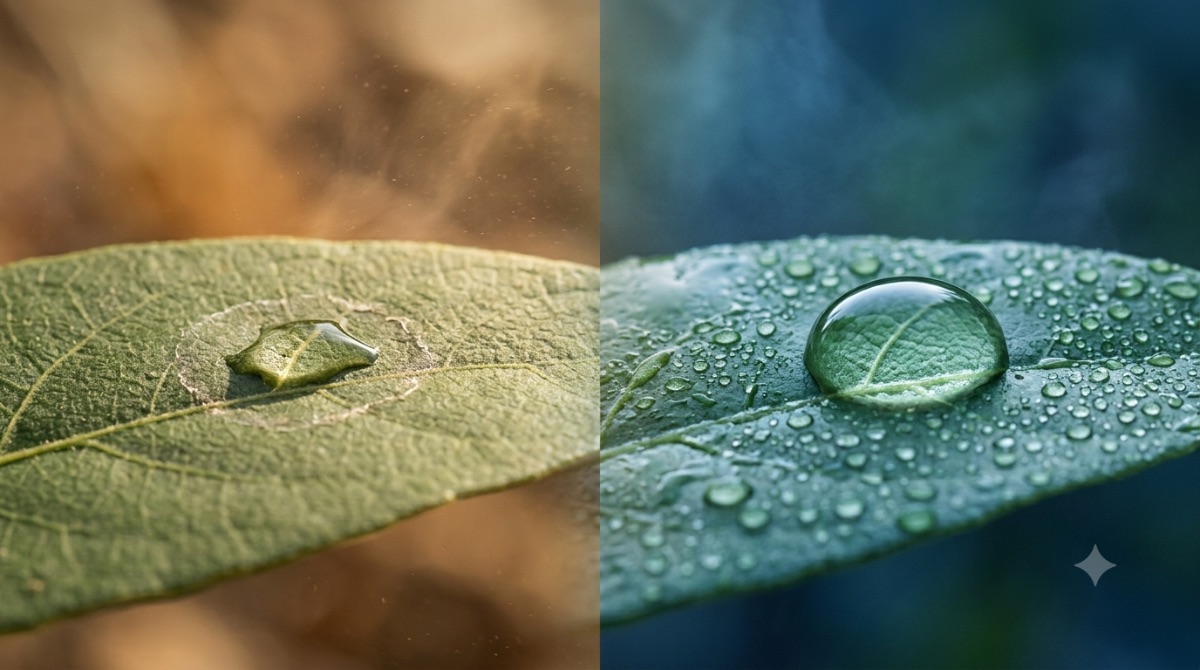
There is a number that shows up on ag weather stations and handheld meters, that almost nobody looks at, and that predicts better than any other whether you are about to lose product into the air.
It is called Delta T. And unlike wind — which you can see, feel, and which everybody respects — Delta T is invisible. A day with a Delta T of 12 looks identical to one with a Delta T of 5. You see the difference afterward, in the result.
What it is, in one sentence
Delta T is the difference between air temperature and wet-bulb temperature.
That sounds abstract until you translate it into what it means in the field:
Delta T measures how thirsty the air is.
Air with a high Delta T is dry and greedy air, pulling water out of anything it can reach — including the droplet you just sprayed. Air with a low Delta T is nearly saturated: it cannot take on more water, and the droplet stays liquid where it lands.
What wet-bulb temperature is
It is the lowest temperature you can reach by evaporating water into that air.
The classic way to measure it: wrap a thermometer bulb in wet gauze and fan it. The water evaporates, and evaporating steals heat, so the thermometer reads lower than the dry one. How much lower depends on the humidity of the air.
- Very dry air — water evaporates fast — steals a lot of heat — wet bulb well below air temperature — High Delta T
- Saturated air — water does not evaporate — steals no heat — wet bulb almost equal to air temperature — Delta T near zero
So Delta T is, at bottom, a measure of humidity — but far more useful than relative humidity on its own, because it folds in temperature. 70% humidity at 15 °C and 70% at 35 °C are entirely different worlds for a droplet; Delta T tells them apart, the percentage alone does not.
How it is obtained
You do not need a gauze thermometer. It is calculated from temperature and relative humidity, two figures any station or forecast provides.
The most widely used wet-bulb formula in applied meteorology is the approximation published by Roland Stull in 2011 in the Journal of Applied Meteorology and Climatology. It is the one ag weather stations use — not a rule of thumb.
Then: Delta T = air temperature − wet-bulb temperature.
The range: 2 to 8
The internationally accepted operating range for pesticide application is Delta T between 2 and 8. Some regional guides extend it to 10 in naturally dry climates. Each end fails for a different and opposite reason.
Below 2: the droplet that will not dry
The air is practically saturated. The droplet reaches the leaf and stays liquid too long.
What happens then:
- Runoff. Droplets merge, form a film, and that film runs down the leaf to the ground. You applied to the plant; the product ended up in the soil.
- Uneven deposition. What runs off does not spread evenly: it pools at edges and along the veins.
- Dangerous company. A low Delta T usually comes with the very conditions that produce a thermal inversion — calm, cool, humid air. A Delta T below 2 is also an indirect warning that an inversion may be present.
Above 8: the droplet that disappears
The air is dry and greedy. The droplet starts evaporating in transit, before it touches anything.
What happens then:
- It shrinks. A droplet losing water loses diameter and mass. And a smaller droplet falls slower — much slower.
- It becomes drift. A 200-micron droplet falls at a decent rate. If it evaporates down to 100 microns, its fall speed collapses and it is at the mercy of the wind. The droplet you were going to deposit is now the droplet that leaves.
- It concentrates. What is left is the same active ingredient in less water: a more concentrated, smaller, more mobile droplet.
- Vapor drift. With volatile products, dry air encourages part of the active ingredient to move into the vapor phase and travel on its own, even after it has been deposited.
The net result is the worst of both worlds: less product on target and more product off target.
Why Delta T predicts so well
Almost every factor in an application affects one thing. Delta T affects the two that matter, at the same time:
1. How much arrives (efficacy) 2. How much leaves (drift)
And it does so by multiplying the effect of the other factors. The same 12 km/h wind sends the droplet much farther at a Delta T of 11 than at a Delta T of 4, because in the first case the droplet reaches the point of maximum travel while lighter. Delta T does not compete with the wind: it amplifies it.
That is why a wind reading alone is never enough to decide.
What to do in each case
With Delta T below 2:
- Wait for the sun to raise the temperature and drop the relative humidity.
- Check for a thermal inversion before applying, even if the wind looks fine.
- If you must apply, consider a lower volume per hectare to reduce runoff.
With Delta T above 8:
- The fastest lever is to make the droplet bigger: a coarser nozzle offsets a good share of the evaporation, because a large droplet takes far longer to shrink to a driftable size.
- Lowering application height cuts the time the droplet spends in the air.
- Raising carrier volume helps, but less than people think if the droplet is still fine.
- And often the right answer is simply to move the work to early morning or late afternoon.
The sweet spot in most agricultural regions falls at mid-morning and mid-afternoon: the sun has already broken the dawn inversion, but the air has not yet reached its driest point.
How Recrops solves it
The Weather module calculates Delta T automatically for the field's coordinates, using the Stull (2011) wet-bulb approximation — the same one professional stations use.
No tables to look up, no arithmetic. The Delta T chip shows the current value with its optimal range beside it, and the color of the floating button already folds that factor in alongside the other six: if Delta T is out of range, the verdict reflects it without you having to interpret anything.
And it calculates it for the next 24 hours, hour by hour. That is what turns "Delta T is at 11 today" into something actionable: you can see what time it drops into the good range and schedule the work there, instead of writing off the day.
One honest limit: it is a calculated forecast value, not a measurement in your field. It is good for deciding and for planning; it does not replace a handheld meter if your operation or your regulator requires a recorded on-site reading.
The essentials
- Delta T measures the thirst of the air, combining temperature and humidity into a single number.
- The working range is 2 to 8.
- Low: the droplet runs off and is lost to the soil; also an indirect signal of a possible inversion.
- High: the droplet shrinks, becomes driftable, and part of the product never arrives.
- It amplifies the wind: never read one without the other.
- The fastest lever when it is high is to make the droplet bigger.
This article is for guidance only and does not replace the product label or the rules of your regulatory authority. For your specific products and conditions, consult an extension specialist or a licensed adviser.
Sources: North Dakota State University Extension, Delta T: A Tool for Pesticide Application Decision Making; Washington State University, AgWeatherNet Spray Guide; Stull, R. (2011), Journal of Applied Meteorology and Climatology; University of Nebraska-Lincoln Extension; ASABE S-572 standard (droplet size classification).