The Two Clocks After You Spray
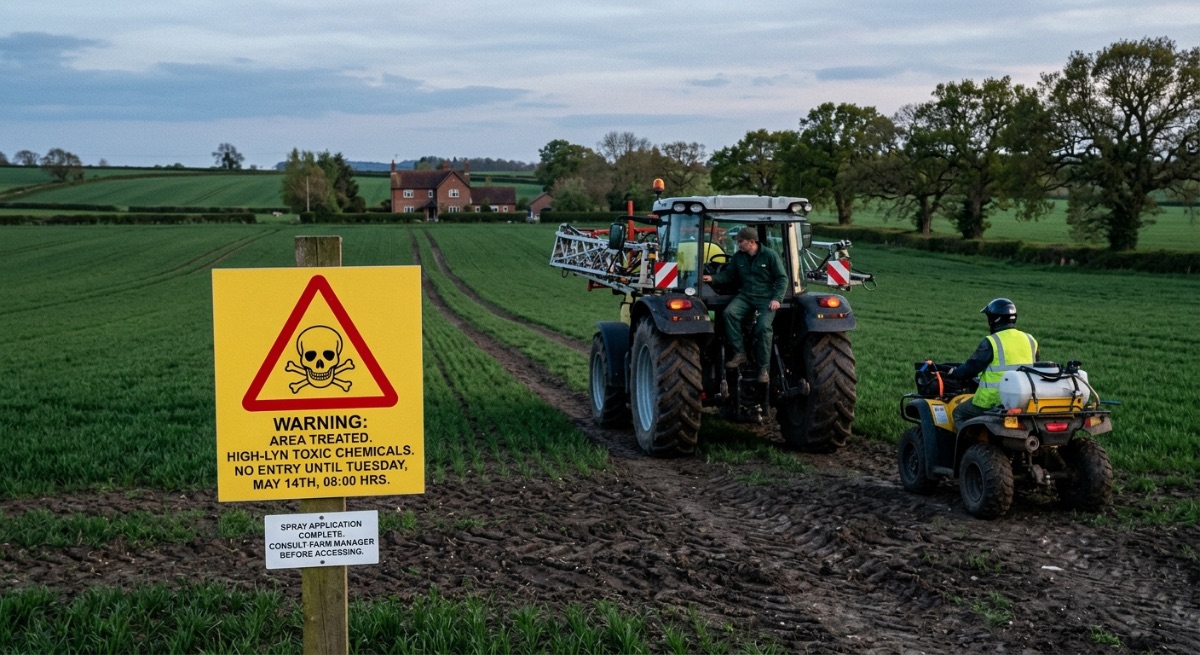
You finish the application, pack the equipment and head to the next field. Behind you two countdowns are running, and neither is entirely yours — but you will hear about both if something goes wrong.
Clock one: the restricted-entry interval
This is the time that must pass before a person can enter the treated area without protective equipment. It protects whoever works after you: the person irrigating, weeding, tying, harvesting.
It is on the label, it is counted in hours from the end of the application, and it varies enormously between products — from a few hours to several days for the most toxic ones. In many jurisdictions the obligation also comes with requirements to post the area and notify workers.
Where it goes wrong most often:
- Nobody was told. The applicator knows the interval; the customer's field crew does not. Without a formal handover of that information, the data stays with you.
- The field was not posted.
- It was counted from the start instead of the finish. On a large field the difference can be hours.
- A tank mix was applied and the interval was taken from the wrong product. With several products in the tank, the longest one governs.
Clock two: the pre-harvest interval
This is the minimum time between the last application and harvest. It exists so residue of the product in the crop falls below the maximum limit allowed for that product and that crop in the destination market.
Here the nature of the risk changes. The entry interval protects a person; the pre-harvest interval protects the goods. Harvesting early can mean a load rejected at the buying point, a shipment held at customs, a lost certification, or the grower shut out of a market entirely. And unlike a badly executed application, this one gets measured: a residue analysis produces a number, and the number is not up for debate.
The specific traps:
- The limit depends on the destination. The same product on the same crop can face different limits depending on where the harvest is headed. The local label's interval is not always enough to export.
- Staggered harvest. In vegetables, continuously picked fruit or multi-cut crops, harvest is not a date: it is a process already running while you spray. The pre-harvest interval collides head-on with the grower's logistics.
- Successive applications. If the field received two treatments, the count starts from the last one, not the first.
- The tank mix, again. With several products, the longest interval in the set governs.
The rule that fixes half the errors. In any tank mix, both clocks are set by the most restrictive product, not the main one and not the most expensive one. It is a one-line rule, and it is the one most often forgotten when three products go into the tank and only one was in the mind of whoever decided.
Why this is the custom applicator's problem
A tempting argument: the product is the customer's, the crop is the customer's, the decision to harvest is the customer's. Partly true, and irrelevant in practice for three reasons.
Because you hold the data. You know what was applied, how much, and the exact time you finished. The grower knows what you told him. If you did not tell him in writing, the data exists only in your memory.
Because when something goes wrong, they come looking for you. A residue above the limit triggers an investigation backwards. The question will be what was applied and when, and the answer will be your record — or the absence of your record.
Because it is the service that sets you apart. An applicator who hands over, along with the job, the re-entry date and the date the field is clear for harvest is solving a real problem for the grower. The one who just sprays and leaves is not.
Turning two dates into something that does not get forgotten
The way this fails in the real world is almost never technical ignorance. It fails on logistics: the information exists but does not reach the person deciding to walk into the field or climb onto the harvester in time.
What needs to happen is short:
- The exact finish time of the application is recorded — not the date, the time.
- The applied products stay attached to that job, with their intervals.
- The two resulting dates are calculated automatically, taking the most restrictive product.
- Those dates reach the customer the same day, in writing, along with the job record.
- They stay visible at the field — posting or signage — while the entry interval is running.
None of that is complex. All of it is lost when the only record is what the operator said to the foreman while loading the truck.
In short: re-entry is counted in hours from when you finished and protects people; pre-harvest is counted in days to harvest and protects the goods. In any mix the most restrictive product sets both, and with successive applications you count from the last. Record the finish time, calculate both dates, and hand them to the customer in writing — it is compliance, and it is also the easiest sales argument you have.
General guidance only. Intervals, residue limits and posting obligations vary by product, crop, country and destination market. Always follow the label and consult your local agricultural authority and a licensed agronomist.
Sources: Montana State University Pesticide Education Program; University of California Statewide IPM Program; Penn State Extension; Codex Alimentarius (maximum residue limit framework).