Thermal Inversion: The Calm Day That Kills
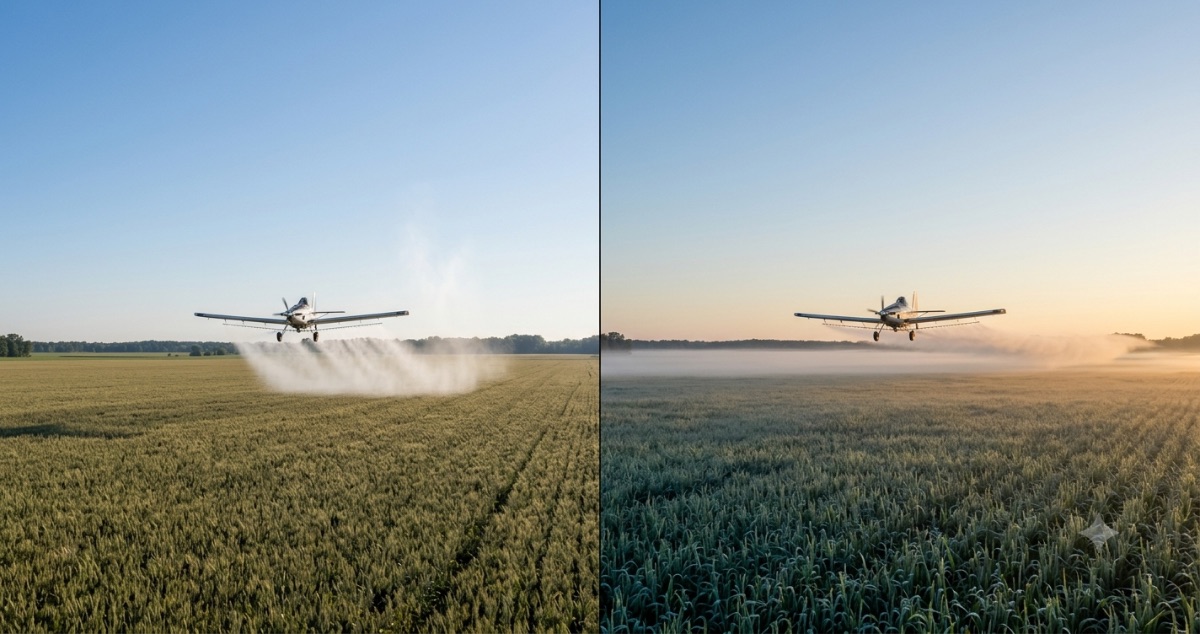
Ask an applicator with years behind them what the best time to spray is, and many will say the same thing: early, at dawn, when there is no wind.
It is the most intuitive answer in the trade. And under certain conditions it is also the most dangerous.
Because a clear, cool, windless dawn is exactly the recipe for a thermal inversion. And under an inversion, a fine droplet does not sit still: it floats, intact, until a gentle current carries it a kilometer away.
What a thermal inversion is
Under normal conditions, air cools with height. The ground warms in the sun, warms the air above it, and that warm air rises. That constant vertical movement — mixing — is what disperses anything suspended in the air, including your application.
In an inversion, the order flips: there is warmer air above than below.
And because cold air is denser, it stays pinned to the ground. It does not rise. It does not mix. What is left is a stable, still layer, capped from above as if it had a ceiling.
How it forms
The typical case is nocturnal and always follows the same sequence:
1. The sun sets. The ground stops receiving heat. 2. The ground radiates its heat to the sky and cools fast. Under a clear sky it cools much more, because there are no clouds to return that radiation. 3. The air in contact with the ground cools with it. The air higher up keeps the day's warmth. 4. By dawn you have cold air below and mild air above: inversion.
That is why an inversion is stronger and more likely when:
- The night was clear
- The wind was calm (wind mixes and breaks the inversion)
- Humidity is high, with dew or low fog
- The terrain is low or enclosed, where cold air pools
And why it breaks when the sun warms the ground enough to restart vertical mixing: typically one to three hours after sunrise, depending on season and location.
Why it is so serious for an application
Here is the counterintuitive part: an inversion does not move the droplet. It preserves it.
Without an inversion, a fine droplet that fails to deposit rises, disperses, and dilutes into an enormous volume of air. It is lost, yes, but lost spread out — the concentration reaching any distant point is negligible.
Under an inversion, that same droplet:
- Cannot rise — the warm layer above blocks it.
- Does not dilute — it stays in a thin sheet of air, concentrated.
- Travels whole — on a gentle 2 or 3 km/h current, for hours.
The result is a concentrated cloud of product drifting slowly at ground level. It can travel hundreds of meters or several kilometers, and settle far away, still at a concentration high enough to damage a sensitive crop.
Droplets below roughly 200 microns are the ones that get trapped: they fall so slowly — centimeters per second — that the stable layer holds them indefinitely.
This is the mechanism behind most serious cases of damage to neighboring crops. Not the application in strong wind, which is obvious and everybody avoids: the application in near-zero wind, which looked like the prudent one.
How to detect it
The measurement
The technical way is to compare temperature at two heights. If the upper one is higher than the lower one, there is an inversion. Monitoring networks typically use sensors at about 2 and 10 meters; weather models allow comparing the surface level against higher levels.
The field signs
Without instruments, there are reasonably reliable indicators. None is proof on its own, but several together are a serious warning:
- Smoke does not rise. The classic sign: light a smoke source and watch. If it climbs and disperses, there is mixing. If it flattens out and spreads at a certain height, there is a cap above.
- Fog or haze in the low ground, pooled in hollows.
- Heavy dew on the leaves.
- Smells and sounds carry oddly — you hear distant things with unusual clarity, because the stable layer conducts them.
- Wind below 3 km/h under a clear sky, at night or at dawn.
- A large spread between the day's high and low.
The most dangerous combination, and the easiest to recognize: a clear, windless dawn with dew.
What to do
If you detect an inversion: do not spray. This is not a factor you offset by adjusting something else.
It is not fixed by:
- Coarsening the droplet. It helps, and it is always worth doing, but any application produces a percentage of fines. Under an inversion, that percentage is enough.
- Lowering the height. Reduces the problem, does not eliminate it.
- Spraying faster. Only distributes the same error over less time.
What does work is waiting. The inversion breaks on its own when the sun warms the ground. In practice, that means moving the work one or two hours later than habit dictates.
Many product labels say so explicitly: they prohibit application under thermal inversion conditions. That is not a best-practice suggestion — in those cases it is a condition of use, and spraying anyway can carry regulatory consequences on top of agronomic ones.
How Recrops solves it
The Weather module compares the temperature at surface level against the temperature at 80 meters, at the field's coordinates. If the upper one is higher, there is an inversion.
It is one of the only two factors with absolute veto power in the system: with a confirmed inversion the verdict is red even if Delta T, wind and rain are perfect. It is not averaged with anything.
There is also an intermediate "near-inversion" state — when the gradient sits in the transition band — that leaves the day in caution rather than blocking it. The chip shows it in two words: well-mixed air or stagnant air.
And there is one detail worth explaining, because it is what makes the whole thing useful: an inversion changes how wind is read. Recrops does not penalize low wind automatically. It only flags calm as a problem when it also detects stagnant air. With good vertical mixing, 2 km/h is simply light wind, not an alert. That distinction is exactly what separates a quiet day from a dangerous one, and it is what a plain wind traffic light cannot do.
An important and honest limit: the 80-meter figure is modeled, not measured by a sensor in your field. It is there to guide the decision and to tell you to look at the field — not to certify the absence of an inversion. When the system says there is an inversion, believe it. When it says there is none on a clear, windless, dewy morning, check the smoke anyway.
The essentials
- Inversion = warmer air above than below. It acts as a cap.
- It forms on clear, calm nights; it breaks one to three hours after sunrise.
- It does not move the droplet: it preserves it concentrated and lets it travel kilometers on minimal wind.
- It is the mechanism behind serious third-party damage cases.
- Clear dawn + no wind + dew = the worst combination, and the one most often mistaken for the ideal.
- It cannot be offset with equipment. The only correct response is to wait.
Keep reading:
This article is for guidance only and does not replace the product label or the rules of your regulatory authority. For your specific products and conditions, consult an extension specialist or a licensed adviser.
Sources: North Dakota State University Extension, Understanding Air Temperature Inversions Relating to Pesticide Drift (AE1876) and Air Temperature Inversions: Causes, Characteristics and Potential Effects on Pesticide Spray Drift; Purdue University, Office of Indiana State Chemist; Iowa State University Extension and Outreach; University of Nebraska-Lincoln Extension, Spray Drift of Pesticides (G1773).