7 Weather Data Points That Decide Your Spray
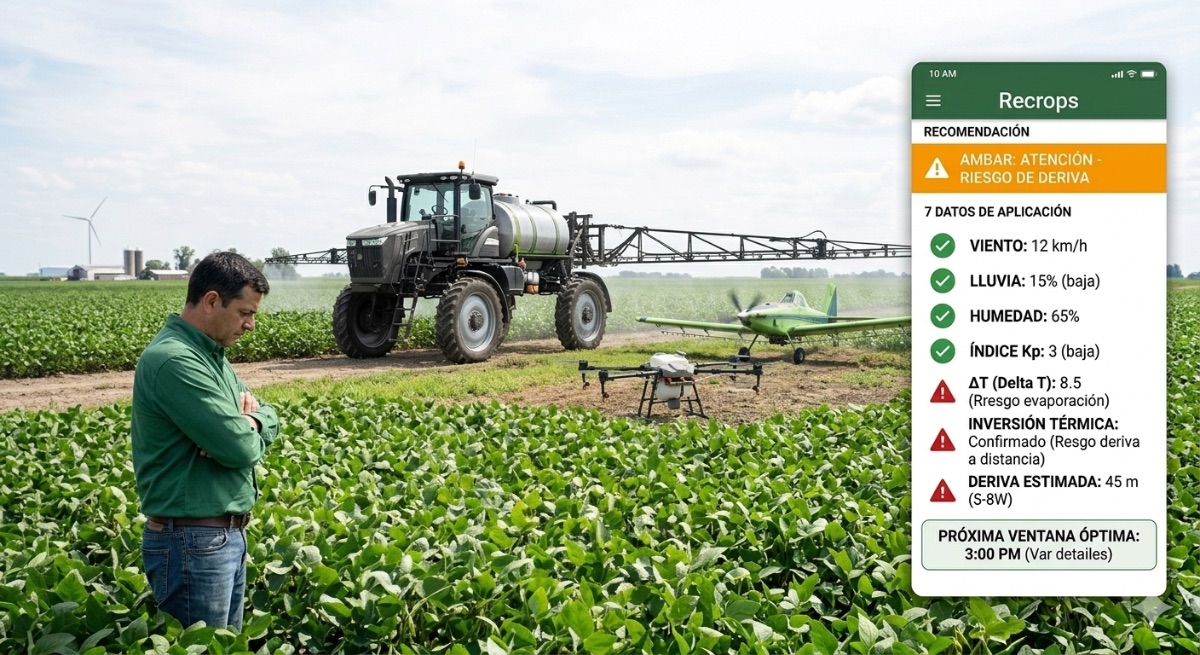
It is 10 in the morning. The tank is loaded, the customer is waiting, and a decision has to be made: do we spray or not?
By eye, the day looks fine. No rain, a bit of breeze, the sun is warming up. But "looks fine" and "is fine" are not the same thing. A good share of the product lost in an application is not lost to a bad rate or bad equipment: it is lost because the conditions were not what they appeared to be.
Seven data points. Four everybody knows. Three are almost always ignored — and they are exactly the ones that explain the days when "everything was fine" and the job still went wrong.
This is the overview. Each one has its own article, linked below.
1. Wind: both ends matter
The working range is 3 to 15 km/h. Above 15, obvious drift; anybody knows that.
What almost nobody considers is the lower end. Below 3 km/h a fine droplet does not deposit: it stays suspended in the air, and when the air moves — an hour later, in any direction — it travels far. Calm is not a synonym for safe.
There is a nuance that matters: low wind is only a real problem when the air is also stagnant. With good vertical mixing, light wind is simply light wind. That is why this factor cannot be read on its own — it is read together with thermal inversion.
2. Delta T: the best predictor of lost product
It is the difference between air temperature and wet-bulb temperature. In practice it measures how much capacity the air has to evaporate the droplet before it reaches the leaf.
The accepted range is between 2 and 8. Below 2, the droplet does not evaporate, runs off and is lost to dripping. Above 8, the droplet shrinks in the air and what is left is so light that it goes with the wind.
A 32 °C day at 40% humidity looks splendid and is terrible for spraying. Delta T is the figure that gives it away, and it is calculated from two numbers anybody has at hand.
→ What Delta T Is, and Why It Decides Your Application
3. Thermal inversion: the invisible enemy
Normally air cools with height. In an inversion the opposite happens: there is a layer of warmer air above, acting as a lid. The fine droplet gets trapped in a sheet of air and travels horizontally, intact, for hundreds of meters or kilometers.
It is the mechanism behind most serious cases of damage to neighboring crops. And the dangerous part is that it happens precisely under the conditions that look ideal: a clear, windless, cool dawn.
Of the seven factors, this is one of the two with veto power: with a confirmed inversion you do not spray, even if everything else is perfect.
→ Thermal Inversion: Why the Prettiest Day Is the Most Dangerous
4. Rain: the threshold is 30%
Rain before the product is absorbed washes it off and sends it to the ground: you lose the product, you lose the trip, and in many cases you have to repeat the whole application.
The critical period depends on the product — the label rules — but the operational rule is simple: above 30% probability during the application hour, wait. What matters is not just knowing it will rain, but when the front passes, so you can reschedule instead of cancel.
5. Estimated drift: how many meters, and which way
"There's a bit of wind" is not actionable. "The droplet can travel 24 meters to the northeast, and up to 38 in a gust" is: it tells you whether the neighboring field is at risk before you take off.
The distance depends on four things you already know about your own equipment: the nozzle's droplet size, the application height, the wind (and its gust), and Delta T, which shrinks the droplet and makes it travel farther.
Switching to a coarser nozzle or lowering the height are thirty-second decisions — if you know they are needed.
→ Drift: How Many Meters Your Application Really Travels
6. The Kp index: when the sun misaligns your flight
A global index of geomagnetic activity, from 0 to 9. It has nothing to do with local weather, and almost no application tool shows it.
A geomagnetic storm degrades satellite positioning accuracy. For an aircraft flying parallel lines to centimeter precision, that means miscalculated overlaps, untreated strips and double strips. The equipment throws no error: it flies wrong, and the problem shows up later, in the crop.
It is the second factor with veto power.
→ The Kp Index: It Can Ruin Your Application — or Cause a Crash
7. Relative humidity
It does not decide on its own, but it is half of the Delta T calculation. Very dry air evaporates; saturated air does not let things dry. Its real operational value lies in what it produces combined with temperature.
How they are read together
The most common mistake is not ignoring a data point: it is reading them separately.
- Thermal inversion changes the meaning of wind. 2 km/h with well-mixed air is acceptable. The same 2 km/h under an inversion is dangerous.
- Delta T changes the meaning of drift. The same wind, in dry air, sends the droplet considerably farther, because it arrives lighter.
- Two factors override the rest. A confirmed inversion and a Kp at alert level block the application even if the other five are perfect. They are not offset by anything.
And the question that really organizes the day
The seven data points answer "do I spray now?". The other one is missing: "and if not now, when?"
Evaluating the next 24 hours hour by hour — with the full criteria, not just wind — turns a cancellation into a reschedule. Instead of "it can't be done today", the conversation with the customer is "a four-hour window opens today at 3 in the afternoon".
How Recrops solves it
Recrops' Weather module calculates the seven factors for the field's exact coordinates — not the nearest city — and sums them up in a single signal: a floating button whose color is the verdict. Green, amber or red, visible throughout the app without opening anything.
Tap it and the panel says which specific factor is failing — it does not just say "do not spray", it says why. And it shows the next 24 hours, hour by hour, with the next optimal slot marked.
Location is resolved by GPS, by registered field (fields with coordinates from your orders appear in a list), or by searching anywhere in the world to quote a new job. Data refreshes every 15 minutes and works in any country.
What it does not do: it does not measure, it forecasts. There is no sensor in your field — these are weather models, and models fail. The drift estimate is not a regulatory value and does not replace the distances your authority requires. Every figure has to be verified in the field. The module tells you where to look; the eyes are still yours.
In summary
- Wind — good range 3 to 15 km/h. Out of range: drift, or a suspended droplet that travels later.
- Delta T — good range 2 to 8. Out of range: product that evaporates or runs off.
- Thermal inversion — you need well-mixed air. Under inversion: drift for kilometers, the serious case.
- Rain — up to 30% probability. Above that: a washed-off application, a repeated trip.
- Estimated drift — under 10 meters. Above that: damage to the neighboring field.
- Kp index — below 4. Above that: bad overlaps, untreated strips.
- Relative humidity — does not decide alone; it feeds the Delta T calculation.
None of these data points is new. What is new is having them all, together, for your field, on a single button — instead of scattered across three apps, a printed table and experience.
The Weather module is included in every paid Recrops plan. The Free plan shows it locked.
This article is for guidance only and does not replace the product label or the rules of your regulatory authority. For your specific products and conditions, consult an extension specialist or a licensed adviser.
Sources: North Dakota State University Extension; University of Nebraska-Lincoln Extension; Purdue University, Office of Indiana State Chemist; Iowa State University Extension and Outreach; Stull, R. (2011), Journal of Applied Meteorology and Climatology; ASABE S-572 standard; NOAA Space Weather Prediction Center.