Spray Drift: How Many Meters It Travels
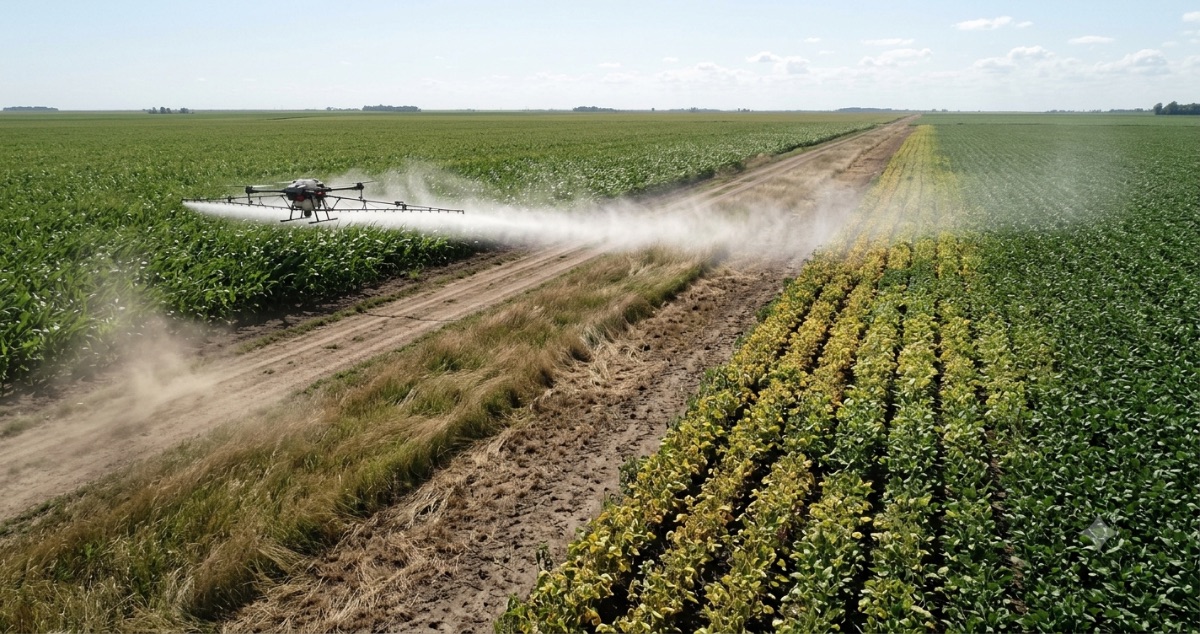
"There's a bit of wind, but we can go."
That sentence decides thousands of applications every day, and it means nothing. Can go for what? With which nozzle? At what height? And the field next door, with what crop in it?
Drift is not a matter of judgment. It is physics, and it can be estimated in meters. And once you turn it into a number, it stops being an argument and becomes a thirty-second decision.
What determines the distance
When you release a droplet, two things happen at the same time:
- It falls, at a speed that depends on its size.
- It moves sideways, carried by the wind.
The distance it covers is, in essence, the result of that race:
Distance ≈ wind speed × time spent in the air
And time in the air is height divided by fall speed. Four variables, all of them under your control except one.
1. Droplet size — the variable that rules
It is by far the dominant factor. And not linearly: fall speed collapses as the droplet gets smaller.
Real orders of magnitude for fall speed in still air:
- 50 µm — 0.075 m/s
- 100 µm — 0.27 m/s
- 200 µm — 0.72 m/s
- 400 µm — 1.6 m/s
Read those numbers carefully. A 400-micron droplet falls more than 20 times faster than a 50-micron one. From 3 meters up, the 400 takes under 2 seconds; the 50 takes 40 seconds. In a 10 km/h wind, those 40 seconds are more than 100 meters of travel.
That is why droplet size classification (the ASABE standard, from very fine to ultra coarse) is the first thing any serious drift-reduction program looks at. Changing nozzles moves the needle more than anything else.
2. Application height
It enters the equation directly: twice the height is twice the time in the air, and therefore twice the travel.
It is the cheapest lever there is — lowering costs nothing — and the most wasted, because height is usually set for flying comfort or out of habit, not for the day's conditions.
3. The wind, and above all the gust
Wind speed multiplies everything above. But the number that really matters for the worst case is not the mean wind: it is the gust.
An application is judged by its worst moment, not by its average. If the mean wind is 10 km/h with gusts to 18, the drift distance of the worst instant is nearly double what you would calculate from the average.
4. Delta T — the factor almost nobody puts in the equation
This is where most estimates fall short.
A droplet in transit evaporates while it travels. It loses diameter, loses mass, and — per the numbers above — losing diameter means falling slower. It is a self-reinforcing loop: the longer it spends in the air, the more it shrinks; the more it shrinks, the longer it spends in the air.
In dry air (high Delta T), a droplet that left as "medium" can behave as fine halfway there. That is why the same wind produces very different drift depending on Delta T, and why an estimate that looks only at wind underestimates the problem on exactly the days when it matters most.
From the number to the decision
An estimate in meters is good for three concrete things:
1. Knowing whether the neighbor is at risk. If the estimate says 8 meters and the boundary is 60 away, the conversation is over. If it says 35 and the boundary is 20 away, it is also over — the other way.
2. Knowing which lever to pull. The options, in order of effect:
- Coarsen the droplet — the biggest effect per unit of effort. A coarser nozzle can cut drift to a fraction.
- Lower the height — direct, proportional effect, zero cost.
- Wait for the wind or the gust to drop — sometimes that is two hours.
- Change the direction of the passes so the wind carries the droplet away from the sensitive boundary instead of toward it.
3. Knowing which way. Wind is reported as the direction it comes from; the droplet travels the opposite way. It is a common source of error and it costs a crop. With a north wind, drift goes south.
What an estimate is not
Worth saying plainly, because this is where things get confused:
An estimated distance is not a regulatory buffer zone. The distances your authority or the product label requires are mandatory and are set by a different criterion. The estimate is an operational decision tool: it tells you whether today, with this equipment and this wind, something should change. It does not authorize you to shorten a legal distance.
Nor is it a measurement. Wind is a forecast. A reasonable ballistic model can tell you the order of magnitude — 8 meters or 40 meters — with confidence; it cannot tell you it will be 23.4.
And there is one case where all this physics falls short: under a thermal inversion, the droplet does not fall according to this calculation, because it gets trapped in a stable layer and can travel kilometers on minimal wind. If there is an inversion, the wind-driven drift calculation is the least of it.
How Recrops solves it
Recrops' drift estimator combines the four factors with an honest ballistic model: time in the air = height ÷ droplet fall speed, distance = wind × time × an evaporation factor derived from Delta T.
Three design decisions worth explaining:
- It uses an empirical fall-speed table, not the Stokes formula. Stokes overestimates above 150 microns, which is exactly the range most agricultural applications work in.
- It gives two figures: the typical and the worst. One with the mean wind, one with the gust. Because an application is judged by its worst moment.
- It reads the parameters from the order you already have loaded — height, overlap and droplet size. Nothing to retype.
The result is shown with its own traffic light — green below 10 meters, amber between 10 and 30, red above 30 — and with the direction the droplet travels, on a compass, already converted (not the wind direction: the drift direction).
The limits, stated plainly: it is not a regulatory value and it does not replace the distance your authority or the label requires. Wind is a forecast — verify it on site before applying. And if the module flags a thermal inversion, the wind-driven drift number stops being the relevant figure.
The essentials
- Drift ≈ wind × time in the air; time in the air is set by droplet size and height.
- Droplet size rules: a 50 µm droplet falls 20 times slower than a 400 µm one.
- Use the gust, not the mean wind, for the worst case.
- Delta T amplifies everything: dry air shrinks the droplet and makes it travel farther.
- The droplet travels the opposite way from where the wind comes.
- An estimate does not replace a legal buffer zone.
- Under a thermal inversion, this physics does not apply: the droplet travels kilometers.
Keep reading:
- What Delta T Is, and Why It Decides Your Application
- Thermal Inversion: Why the Prettiest Day Is the Most Dangerous
This article is for guidance only and does not replace the product label or the rules of your regulatory authority. For your specific products and conditions, consult an extension specialist or a licensed adviser.
Sources: University of Nebraska-Lincoln Extension, Spray Drift of Pesticides (G1773); North Dakota State University Extension; ASABE S-572 standard (nozzle droplet size classification); University of Minnesota Extension; Stull, R. (2011), Journal of Applied Meteorology and Climatology (wet-bulb calculation for the evaporation factor).