Droplet Size: The Core Trade-Off
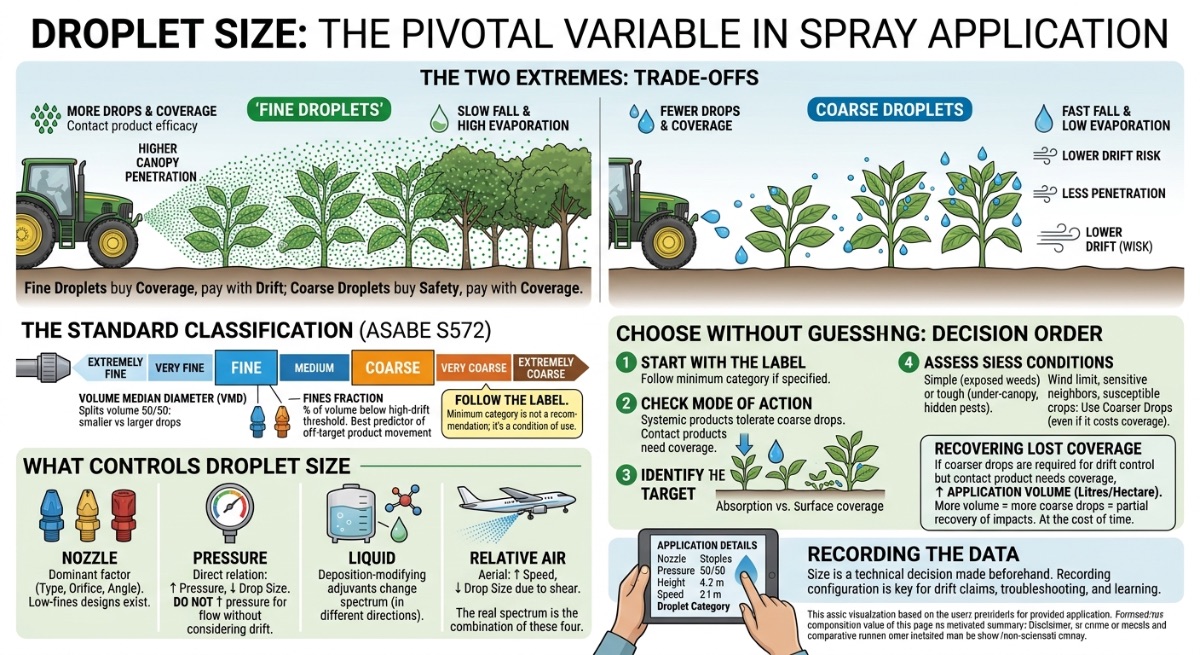
Of all the variables an applicator controls, droplet size moves the most things at once. It changes coverage on the target, it changes canopy penetration, it changes how much product arrives and it changes how much leaves the field. And unlike the weather, it is a variable you choose.
The problem is that the two things you want pull in opposite directions.
The two extremes
Fine droplets. For the same spray volume, smaller droplets mean many more droplets, and therefore many more impacts per square centimetre. That is coverage, and coverage is what decides the efficacy of every contact product: protectant fungicides, contact insecticides, desiccants. It also penetrates better between leaves.
The cost: a small droplet falls slowly and evaporates fast. It spends more time in the air, and that time is exactly what the wind needs to take it away.
Coarse droplets. They fall fast, resist evaporation, and land where you aimed. This is the primary tool against drift.
The cost: fewer droplets per hectare. Fewer impacts, less coverage, more chance that part of the target receives nothing — and with contact products, what receives nothing is not controlled.
The standard classification
"Fine" and "coarse" would be useless as loose words, so a classification exists: ASABE S572, which groups spray patterns into named, colour-coded categories, from extremely fine to ultra coarse, taking in very fine, fine, medium, coarse, very coarse and extremely coarse.
Two concepts worth separating:
- The volume median diameter is the value that splits the applied volume in half: half the liquid sits in droplets smaller than that diameter, half in larger ones. It is the figure that defines the category.
- The driftable fines fraction is the percentage of the volume carried in droplets below the threshold considered high drift risk. This is the number that actually predicts how much product leaves your field.
They are different data and you need both. Two setups can share the same category and have very different fines fractions: the spectrum is not a single number, it is a whole distribution.
What matters about the classification. More and more labels specify a minimum droplet category for applying the product. When the label says it, it is not a recommendation: it is part of the conditions of use, and spraying below that category is spraying off-label.
What controls droplet size
- The nozzle. The dominant factor: type, orifice size and angle. There are designs made specifically to cut the fines fraction.
- Pressure. More pressure, smaller droplets — the relationship is direct and immediate. Raising pressure to gain flow is one of the quietest ways to generate drift.
- The liquid. Deposition-modifying adjuvants change the droplet spectrum, and not all of them in the same direction.
- Relative airflow. In aerial application, the airflow across the nozzle shears the droplets: at higher speed, finer droplets from the same nozzle at the same pressure. Nozzle orientation relative to the airflow counts too.
All four combine. That is why your machine's real spectrum is not the catalogue's: it is your nozzle, at your pressure, with your mix, at your speed.
How to choose without guessing
The decision order that works:
- Start with the label. If it specifies a minimum category, that is the floor and it is not up for debate.
- Look at the mode of action. A systemic product moves inside the plant: it only needs to arrive, and it tolerates coarse droplets well. A contact product has to physically cover the target: it needs more impacts.
- Look at the target. Exposed emerged weeds, straightforward. The underside of leaves in a closed canopy, or an insect hiding at the base of the plant, demands penetration and coverage.
- Look at conditions and at what is around you. Wind at the limit, a sensitive neighbour, a susceptible crop next door: raise the droplet category, even at the cost of coverage.
How to recover the coverage you lose. If drift forces you to go coarse and the product needs coverage, the compensation is to raise the application volume: more litres per hectare means more coarse droplets, and you recover part of the lost impacts. It costs more refill cycles and fewer hectares per day — that is the price, and it is a price you can calculate.
The record worth leaving behind
Droplet size is a technical decision taken before spraying that nobody can reconstruct afterwards by looking at the field. If a drift complaint ever arrives, or if you simply want to understand why one treatment worked better than another, what you need is in the setup: nozzle, pressure, height, speed and the resulting droplet category.
It is information that already exists in your operation. The difference between having it and not is whether it got written down somewhere on the day it was used.
In short: fine droplets buy coverage and pay in drift; coarse droplets the other way around. The label sets the floor, the product's mode of action sets the need, and the day's conditions set the limit. When you have to coarsen the droplet, raise the volume to recover impacts — and record the setup, because it is the only trace of a decision nobody can see afterwards.
General guidance only. Always follow the product label and your equipment manufacturer's charts, and consult a licensed agronomist or extension specialist.
Sources: ASABE S572 (spray droplet spectra classification); University of Nebraska-Lincoln Extension; Penn State Extension; Purdue University Extension.