How to Calibrate Your Spray Rate
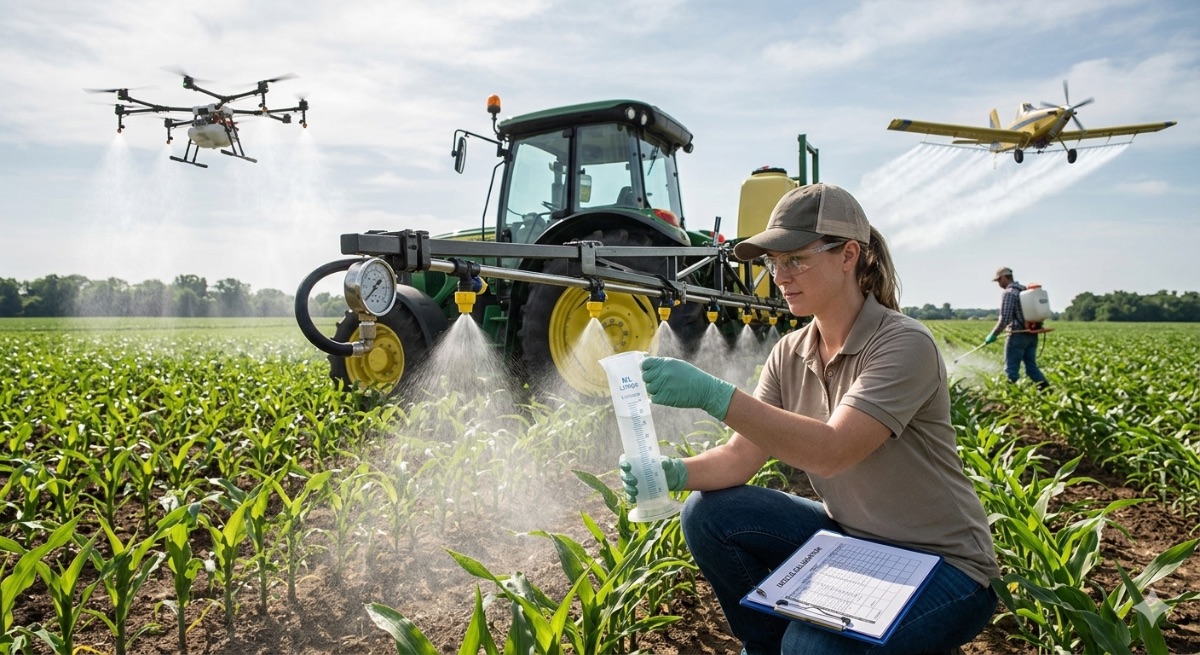
A pesticide label tells you how much active ingredient each hectare should receive. Your machine does not deliver active ingredient: it delivers litres of spray mix. The bridge between the two is your application rate — the litres per hectare actually leaving the nozzles — and if that number is wrong, everything else is wrong too, however precisely the mix was prepared.
The uncomfortable part is that the error is invisible in both directions:
- Under-application: control is partial. Easy to mistake for resistance, for bad timing, or for a product that "does not work any more". And if resistance is what you are building, chronic under-dosing is one of the most efficient ways to build it.
- Over-application: you pay for extra product on every hectare, you raise the risk of crop injury and of residues above the limit, and in many jurisdictions you are applying off-label, which is an offence with a name.
Neither shows up the next day. That is why calibration is not a maintenance chore: it is quality control on the product you sell.
The formula, and what moves it
Three variables govern the application rate of any hydraulic sprayer, ground boom or aerial system: L/ha = (total flow in L/min × 600) ÷ (swath width in m × speed in km/h). The 600 is only the unit conversion, and total flow is the sum of all active nozzles.
Read it as a relationship, not as a sum: double the speed, half the litres per hectare. It is the most common source of error in the field — the operator speeds up to finish before the wind picks up and, without touching anything else, applies half the dose. The arithmetic is merciless and it gives no warning.
All three can be adjusted, but they are not equally free:
- Flow: changed by nozzle size or by pressure. Pressure gives little leverage — you have to quadruple it to double the flow — and it also shifts droplet size, which is your drift control. Changing nozzles is almost always the right route.
- Swath width: the measured effective width, not the nominal one, and on aerial equipment it depends on application height.
- Speed: the easiest variable to move, and the one that moves on its own.
The calibration procedure
With mixing-and-loading protective equipment, and with clean water, never with product.
Check before you measure
Calibrating a machine with worn nozzles measures a problem instead of fixing it. First: clean filters, no leaks, all nozzles of the same type and size unless the design says otherwise, and a visually even spray pattern with no streams and no dead sectors.
Measure the flow of every nozzle
At real working pressure, collect the output of each nozzle in a graduated container over a timed period — 60 seconds gives the cleanest reading; 30 seconds works if you double it.
Compare each nozzle against the average of the set. The criterion extension calibration guides teach: a nozzle more than 10% off the average gets replaced. And if several read high, it is not coincidence — it is general wear, and the whole set has reached the end of its life. A worn nozzle always delivers more, never less.
Measure the real speed
The gauge reading does not count: it measures what turns, not what advances. Mark a known distance and time the run under working conditions — machine loaded, same ground, same application setup. The sum is speed in km/h = distance in m × 3.6 ÷ time in s: 100 metres covered in 18 seconds gives 20 km/h.
Determine the effective swath width
On a boom with evenly spaced nozzles, effective width is the number of nozzles times the spacing between them. In aerial application it has to be measured: water-sensitive paper or collectors laid in a line across the pass, spraying at working height and speed, reading where deposition falls below the acceptable threshold. That width changes if you change height, droplet size or machine — it is not inherited from another setup.
Calculate and adjust
Put the three numbers into the formula. If the result is not your target rate, adjust — nozzles first, then speed, pressure last and within the range that preserves the droplet size you need.
The check that confirms everything
The step that separates someone who calibrated from someone who thinks they did. Calibration is arithmetic from three measurements; verification is a single measurement of the result, and it catches errors in all three at once.
Load a known volume of water, spray over a known area under working conditions, and measure what you used: actual L/ha = litres used ÷ hectares covered. If that number does not match your calculation within ±5%, something you measured earlier is wrong — almost always the speed or the effective width.
It is the reality check. One data point, five minutes, and it confirms or destroys the whole procedure.
How often. At the start of the season; when you change nozzles, product or target rate; every 40-50 working hours in peak season; and any time the mix consumption per field stops matching what you expected. That last one is your free drift detector: if the same field starts drinking more mix than last month, your nozzles are telling you something.
What calibration does not fix
A perfectly calibrated machine can still spray badly:
- Wrong overlap between passes — double strips or empty strips. A machine with exact flow and badly set guidance applies twice as much over a few metres and nothing over others.
- Drift. The litres left the nozzle; the wind decides where they land.
- Wrong height in aerial application, which distorts the effective width you just measured.
- Insufficient agitation — the rate is right but the concentration is not uniform inside the tank.
Calibration guarantees how much comes out. The rest of your technique decides where it lands.
Write it down or lose it
A calibration that lives in the memory of the operator who did it disappears with the first staff change. What to keep per machine is short: date, nozzle type and size, pressure, speed, effective width, target rate, verified rate, and which nozzles were replaced.
That record earns its keep three times: it tells you when the next one is due, it shows wear as a trend — average flow creeping up month after month is the life curve of your nozzles — and, if anyone ever questions an application, it is dated evidence that the machine was delivering what the label asked for.
In short: your real rate is flow, width and speed — and speed is the one that gets away from you. Measure all three, calculate, then verify with litres used over area covered, which is the only measurement that cannot fool itself. Replace any nozzle more than 10% off the average, write down what you did, and repeat it when the field's consumption stops adding up.
General guidance only. Always follow the product label and your equipment manual, and consult a licensed agronomist or extension specialist for your specific conditions.
Sources: Penn State Extension; University of Nebraska-Lincoln Extension; Purdue University Extension; Montana State University Pesticide Education Program.