The Jar Test: Check Mix Before You Fill
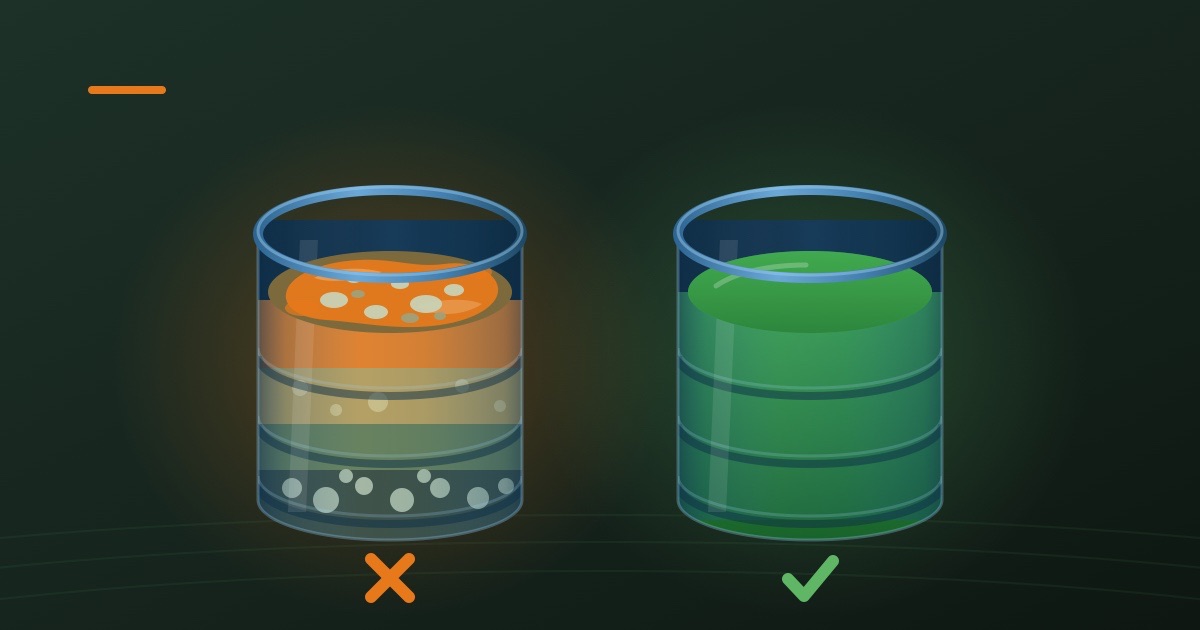
Every experienced applicator has a story about a tank mix gone wrong: a load that turned to cottage cheese, a boom plugged solid halfway across the field, an afternoon lost to draining and flushing 400 gallons of product down the rinse pad. Most of those disasters share one thing — they were preventable in about five minutes with an empty jar.
Tank-mix incompatibility is not rare. As growers stack herbicides, fungicides, insecticides, adjuvants and liquid fertilizers into a single pass to save time and fuel, the number of ways those products can react with each other climbs fast. A jar test is the cheapest insurance you can buy against it.
What "incompatibility" actually means
Not all incompatibility looks the same, and the distinction matters.
Physical incompatibility is what you can see. According to University of Nebraska-Lincoln Extension, physically incompatible products show up as layer separation, gel or "gum" formation, fine solids that won't disperse, or clumping and crystals that settle out. Left in a spray tank, these plug screens, nozzles and filters — and they mean the active ingredient is no longer evenly distributed across the load.
Chemical incompatibility is invisible. Two products can mix into a perfectly uniform, good-looking solution and still be quietly antagonizing each other — one degrading the other, or shifting the water pH into a range where an active ingredient breaks down before it ever reaches the leaf. UF/IFAS notes this plainly: a jar test checks physical compatibility. It does not reveal chemical incompatibility.
Hold onto that. It's the single most important limitation of the test, and we'll come back to it.
Why mixing order causes most physical failures
Penn State Extension and University of Nebraska-Lincoln both stress that physical incompatibility is frequently caused by improper mixing order — not by the products being fundamentally unable to coexist. Dump a dry, water-dispersible product into water that already contains an emulsifiable concentrate, and it may clump instantly. Add the same two products in the right sequence, with agitation between each, and they mix cleanly.
The widely taught sequence is the W-A-L-E-S order:
- W — Water (fill first; always use water from your actual source)
- A — Agitate, and add products in this order:
- L — Liquids and flowables
- E — Emulsifiable concentrates
- S — Surfactants and adjuvants last
Always defer to the mixing order printed on the product label — it overrides the general rule whenever the two disagree.
The jar test, step by step
University extension programs — including Montana State and the University of Arkansas — describe essentially the same procedure.
1. Wear the same PPE you'd wear to mix and load. A jar test usually has no separate PPE listed on the label, so Montana State advises defaulting to the mixing-and-loading requirements on each product's label.
2. Use your real carrier water. Fill a clear quart jar about half full with water from the same source you'll use to fill the sprayer. Water hardness, pH and mineral content are often the cause of the incompatibility you're testing for.
3. Add each product in label order, at tank proportions. Scale each product down to the correct amount for the volume of your jar. Add them in the mixing order above, capping and inverting the jar gently ten times after each addition.
4. Add any conditioners or adjuvants at their proper stage — water conditioners early, surfactants last.
5. Let it stand and watch the clock. Observe the jar immediately, then again after 15 minutes and after 30 minutes, looking for separation, gelling, precipitate, oily films, clumping or heat.
6. Read the result:
- Uniform, pourable, no separation after 30 minutes — the mix is physically compatible. Spray it promptly and keep agitation running.
- Separates but re-mixes with shaking — marginal. Usable only with continuous agitation, never left to sit.
- Gels, clumps, or won't re-disperse — do not load it. Adjust mixing order, drop a product, or split the application.
The gap the jar test leaves — and how to close it
Here's the problem with relying on the jar test alone: it's a physical test with a 30-minute window, and some of the most costly incompatibilities are chemical and time-delayed.
A mix can pass the jar test cleanly and still fail you in the field. The classic example is pH-driven degradation, or alkaline hydrolysis. Many insecticides — organophosphates, carbamates, and several pyrethroids — break down rapidly when carrier water is alkaline. The solution in the jar looks flawless because the active ingredient is still dissolved; it's simply losing potency by the hour. Dithiocarbamate fungicides like mancozeb tell the same story: half-lives stretch to roughly 20 days at pH 5 but collapse to a matter of hours at pH 7-9. Your jar shows nothing. Your disease control just quietly evaporated.
This is exactly the layer a jar test can't reach. Run the actives through a compatibility check first to catch the invisible chemical and pH conflicts; then run a jar test with your real water to confirm the mix is physically sound. One catches what the other can't.
The bottom line: A jar test is five minutes of cheap insurance against a plugged boom — do it every time you build an unfamiliar mix. Just remember what it can and can't see. A clean jar proves your products will mix; it doesn't prove they'll stay effective. Check the chemistry first, then confirm the physics.
General guidance only. Always follow the product label and consult a licensed agronomist or extension specialist for your specific products and conditions.
Sources: University of Florida IFAS Extension; University of Nebraska-Lincoln Extension; Montana State University Pesticide Education; Penn State Extension; University of Arkansas Cooperative Extension.