Maintenance by Hours, Not Months
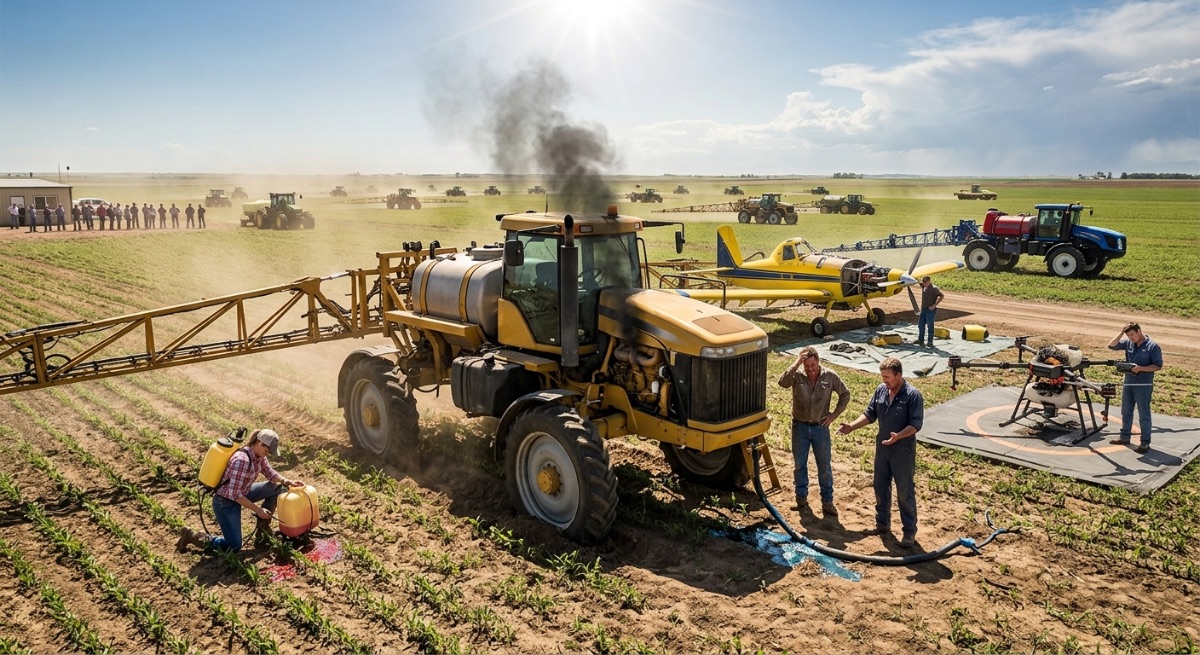
An equipment failure in the off season is an annoyance. The same failure at the peak of the campaign is something else: days lost when every customer needs you at once, jobs that go to the competition, and a weather window that does not come back.
Almost all of those failures announce themselves. The problem is that they announce themselves with small signals — a flow rate creeping up, a minor leak, a new noise — and those signals get recorded in the operator's memory, which is where they go to die.
Why the counter and not the calendar
"Maintenance every three months" is a comfortable and wrong rule. Three months of peak season can be four hundred working hours; three months of off season, forty. Wear does not know what month it is.
A useful plan is based on what the machine did, with three counters:
- Operating hours — the main counter for everything mechanical.
- Hectares treated — the better indicator for the spray system, which wears by litres pumped.
- Charge cycles — the counter that governs battery life, if your machine uses them.
The calendar still has its place, but only for what degrades with time even when the machine sits still: rubber, seals, hoses, and everything that suffers in storage.
The four levels
Every day, before starting
Five minutes, and it is the level that prevents the most stoppages:
- Full visual inspection: fasteners, structure, wiring, connectors.
- Spray system pressurised, looking for leaks.
- Nozzle pattern: no streams, no dead sectors, no dripping.
- Clean filters.
- Battery charge state and physical condition, or fluid levels.
- Tightness of anything that vibrates.
At the end of the day
The most skipped and the most profitable: rinse the entire system with clean water. Spray mix residue drying inside the circuit is the number one cause of ruined nozzles, seized pumps and filters that never recover. A five-minute rinse costs less than any of those three.
When changing products, the rinse stops being maintenance and becomes agronomic safety: herbicide residue in the circuit can damage the crop on the next job.
By block of hours
The exact interval comes from your equipment manual — respect it, do not invent it. What typically belongs at this level:
- Nozzle flow check against nominal, replacing those that deviate.
- Deep cleaning or replacement of filters.
- Inspection of hoses, clamps and seals.
- Pump inspection.
- Structural and moving-parts check.
- Firmware or control software updates, where applicable.
Between seasons
The major overhaul, and the right moment for it is at the end of the season, not at the start of the next one. If you find something that needs a spare part, you have months to source it instead of days. Plus: deep cleaning, full calibration, and correct storage — especially of batteries, which degrade faster stored at full charge than they do working.
The signal you can read. If you record nozzle flow every time you check, wear stops being a surprise: it shows up as a line climbing month after month. A worn nozzle always delivers more, never less. When the line approaches the limit, you order the new set — before the wear starts costing you product on every hectare.
What to write down
The per-machine record is short and earns its keep four different ways:
- Date, accumulated hours and what was done. So you know when the next one is due.
- What was replaced and why. So you learn the real life of each consumable in your conditions, which is the number you need to calculate your cost per hectare.
- Who did it. So you can ask.
- Anomalies observed, even those not acted on. A minor leak noted three times is a pattern; mentioned once out loud, it is nothing.
And if you run more than one machine, that record tells you something no manual can: which of your machines is costing you most per hectare worked. That is the one to replace first, and it is almost never the oldest.
The calculation that decides. A preventive spare part costs what it costs. A day lost at the peak of the season costs the hectares you were going to treat, plus the customer who did not wait, plus the weather window that does not repeat. When the second number is ten times the first, arguing over the price of the part is false economy.
In short: count hours, hectares and cycles, not months. Visual check before starting, full rinse at the end, block of hours per the manual, and the major overhaul when the season closes so you have time to source parts. Record the flow every time you measure it: that climbing line is your only early warning.
General guidance only. Always follow your equipment's maintenance manual and the manufacturer's instructions; intervals vary by model and operating conditions.
Sources: ASABE (agricultural machinery life and maintenance data); University of Nebraska-Lincoln Extension; Penn State Extension.