The Ingredient Nobody Tests
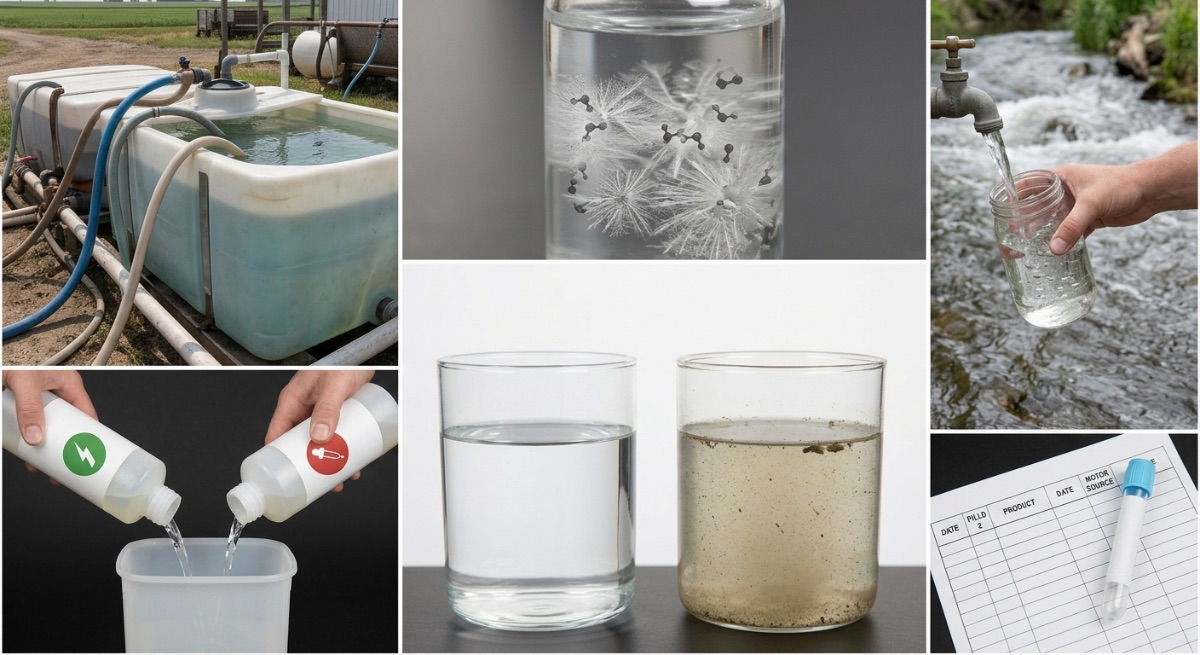
When a treatment does not work, the list of usual suspects is short: timing, rate, coverage, resistance. What almost never appears on that list is the component making up more than 95% of the tank volume, and which in many operations comes out of the nearest well, canal or river without ever having been tested.
Water is not neutral filler. It is a chemical medium with a pH, dissolved minerals and suspended particles, and all three interact with the product you just paid for.
Hardness: the cations that lock up your product
Hard water carries dissolved calcium, magnesium, iron and other cations. Several herbicides — especially those formulated as weak-acid salts — react with those cations in the tank: the herbicide molecule binds to the cation and forms a complex the plant absorbs far less readily. The product is still there, still measurable; it simply can no longer get in.
It is the best documented antagonism in the extension literature, and it affects very widely used products. The treacherous part is that it is invisible: the mix looks perfectly uniform, the jar test passes clean, and control turns out partial two weeks later, when nobody connects the two events any more.
The usual fix is a water conditioner — classically ammonium sulphate — added before the herbicide. The conditioner's cations take the place of the water's, and the herbicide goes in free. The order matters as much as the product: if the conditioner arrives afterwards, the complex has already formed.
One figure worth the test. Hardness is measured in parts per million of calcium carbonate equivalent. A water analysis is cheap, done once per source, and it tells you whether you need a conditioner or whether you are paying for one you do not. Extension offices publish reference thresholds by product type.
pH: the silent degradation
Water pH decides how long the active ingredient survives inside the tank. Many insecticides — organophosphates, carbamates and several pyrethroids — break down by alkaline hydrolysis: in high-pH water the molecule falls apart on its own, and it does it fast.
The timescale is what surprises people. Some products go from a half-life of several days in slightly acidic water to a few hours in alkaline water. That means a mix prepared at six in the morning and sprayed at eleven can have lost a considerable share of its potency before it ever left the nozzle, with no visible sign at all.
Most sensitive products prefer a slightly acidic range. But not all of them: some actives behave worse at low pH, and some modern formulations arrive already buffered and need no adjustment. So the rule is not "always acidify", it is read the label and measure.
Measuring is cheap: test strips for a rough reading, a pocket meter if you spray often. And if correction is needed, an acidifier or buffer at label rate, added to the water before the products.
Alkalinity and bicarbonates: not the same as pH
A common confusion. pH measures current acidity; alkalinity measures the water's capacity to resist changing it, and it comes mostly from bicarbonates and carbonates. Water can have an acceptable pH and still carry high alkalinity that antagonises certain grass herbicides independently of pH.
Practical consequence: if you adjust pH and the problem persists, alkalinity is the next suspect, and it only shows up in a laboratory analysis.
Turbidity: dirty water swallows the active
Muddy water carries suspended clay and organic matter, and some products adsorb strongly onto those particles. Once bound to a clay colloid, the active ingredient still travels to the leaf but is no longer available to act. Cationic contact herbicides are the classic case, but not the only one.
On top of that, sediment and algae block filters and nozzles, and abrasive wear shortens the life of pumps and tips. If your source is surface water — canal, river, reservoir — settling and proper filtration are not optional.
What to do, concretely
- Test every source you use. Once, not every load. Ask for pH, hardness, alkalinity and iron. If you have several sources, test them all: they can differ sharply, even on the same farm.
- Record which source you used on each job. It is the data point that will let you understand, months later, why one field responded differently from another on the same product and the same rate.
- Adjust in the right order: hardness conditioner and pH corrector go into the water before the products.
- Filter and settle if the source is surface water.
- Spray soon after mixing. The longer the mix sits in the tank, the longer the water has to work against you.
The clue that says it is the water. Same product, same rate, same pest, same operator — and different results between fields or between seasons. When the water source changed and nobody wrote it down, that pattern is unreadable. When the source is recorded on the work order, it jumps out.
In short: hard water locks up herbicides, alkaline water degrades insecticides, alkalinity antagonises separately from pH, and muddy water adsorbs the active. None of the four is visible. One analysis per source, a conditioner where it applies, and the source noted on every job turn a recurring mystery into a controlled variable.
General guidance only. Thresholds and conditioning recommendations vary by product. Always follow the label and consult a licensed agronomist or extension specialist.
Sources: Kansas State University Research and Extension; University of Nebraska-Lincoln Extension; Purdue University Extension; Michigan State University Extension.