What a Hectare Really Costs You
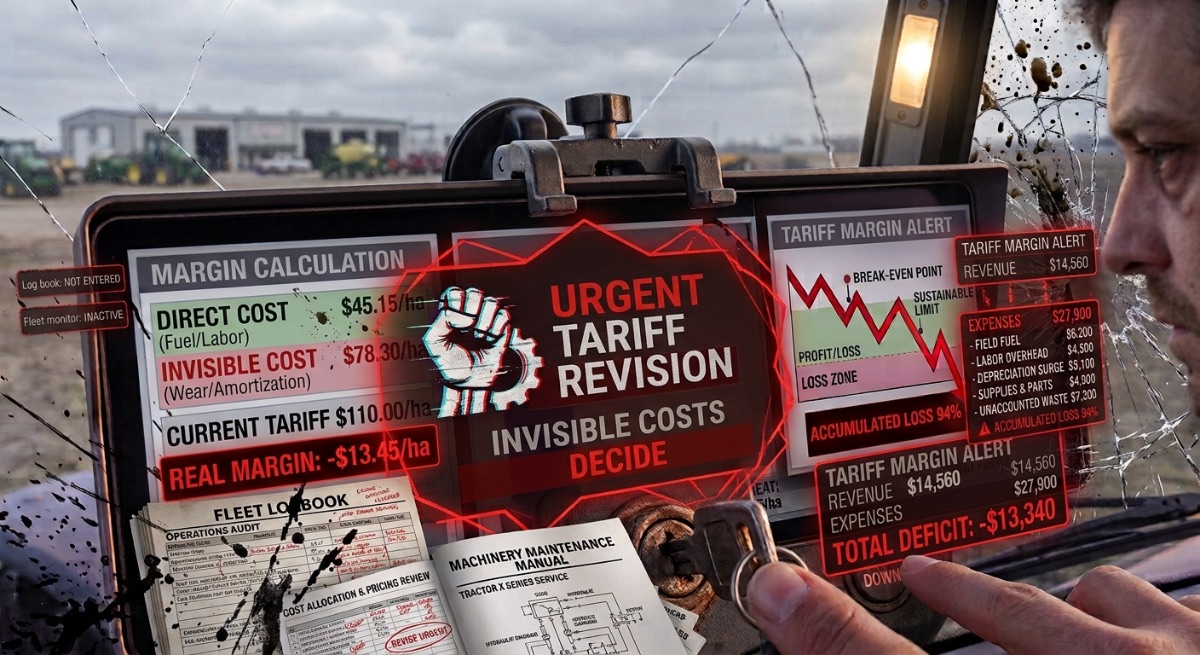
Almost any applicator can tell you, fairly precisely, what he spent yesterday: the energy, the helper's day rate, the fuel for the truck. Very few can tell you what a hectare cost them. And without that number, the rate they charge is not a decision: it is a bet that settles at the end of the year, when it is too late to correct.
The reason the sum comes out wrong is almost always the same: costs paid daily are felt, and costs paid once a year or once every three years are not. But the hectare you treated today consumed a share of both.
The two kinds of cost, and why the split rules everything
Variable costs exist because you sprayed. If the machine sits still, they do not happen. Energy or fuel for the machine, field labour, travel to the field, consumables, nozzle and filter wear, water.
Fixed costs happen whether you spray or not. Equipment depreciation, insurance, licences and permits, premises, software and communications, your own salary or your admin staff's, calendar-based scheduled maintenance.
The practical consequence is the whole game: variable cost per hectare is constant, while fixed cost per hectare depends on how many hectares you treat in a year. Doubling your volume does not cut variable cost by a cent, but it halves fixed cost per hectare. That is why an operation with volume can charge less than you and still earn more — it is not more efficient in the field, its fixed cost is simply spread across more hectares.
The full formula is short: cost per hectare = variable cost/ha + (annual fixed cost ÷ hectares per year). The second term is the one almost nobody calculates, and the one that moves the most.
The variable costs people forget
Everybody has fuel and wages. These three go missing regularly.
Batteries, if your machine uses them
A battery is not a purchase: it is an expensive consumable whose life is counted in cycles. The correct way to cost it is per cycle: cost per cycle = battery price ÷ expected useful cycles, then cost per hectare = cost per cycle ÷ hectares covered per cycle.
With round numbers: if a set costs 1,000 and delivers 400 useful cycles, that is 2.50 per cycle. Covering 2.7 hectares per cycle, it contributes about 0.93 per hectare — multiplied by the number of sets in rotation.
Useful cycles are not the brochure figure: they are the cycles the battery delivers before losing enough capacity that you no longer trust it mid-pass. That point arrives well before the theoretical end of life, and it arrives sooner with fast charging, heat, and storage at full charge.
Consumable wear
Nozzles, filters, hoses, seals, pumps, propellers. Each has a life in hours, and every working hour consumes a fraction of it. Spread per hectare it is a small number — and it is a small number that shows up every month.
Your own time
The most forgotten of all, and the largest in one- or two-person operations. Quoting, scheduling, driving to the field, invoicing, chasing payment, handling complaints. If you do not pay yourself for that time, your operation is not profitable: it is a badly paid job with your own equipment.
The heaviest fixed cost: depreciation
Equipment loses value with use and with time, and that loss is a real cost even though it does not leave your bank account this month. It is money you will have to replace the day the machine retires, and if you did not charge for it in every hectare, that day arrives with no funds behind it.
The basic sum is annual depreciation = (purchase price − residual value) ÷ years of useful life. A machine at 15,000, with an estimated residual of 3,000 over four years, leaves 3,000 a year. Across 1,200 hectares a year that is 2.50 per hectare; across 400 hectares it is 7.50.
That contrast — 2.50 against 7.50 for the same machine — is why volume changes the entire business, and why an idle machine is far more expensive than it looks.
The full sum, worked through
Illustrative numbers, in generic currency units, for an operation treating 1,200 hectares a year. The variable side first:
- Energy or fuel for the machine: 1.80 per hectare
- Batteries, costed per cycle: 2.80
- Field labour: 4.50
- Travel to the field: 2.20
- Consumables and wear: 0.90
Variable subtotal: 12.20 per hectare. Now the fixed side, spread across the year's 1,200 hectares:
- Equipment depreciation: 2.50 per hectare
- Insurance, licences and permits: 1.10
- Premises, software and communications: 0.80
- Admin and your own time: 3.30
Fixed subtotal: 7.70 per hectare. Total cost: 19.90 per hectare.
What matters in those figures is not the amounts — they are invented and yours will differ — but the proportion: fixed costs are 7.70 of 19.90, nearly 39% of the total. An applicator who estimates his cost by adding up what he spent that day arrives at 12.20 and believes he has a comfortable margin. In reality he is working on a third less margin than he thinks, and in slow months — when hectares fall but fixed costs do not — on a negative one.
A slow month is not neutral. Treat half the hectares in a month and your fixed cost per hectare doubles. The rate that left a 20% margin in peak season can be below cost in the off season. That is why cost per hectare should be calculated on annual volume, not on your best month.
Your break-even point
With cost split into fixed and variable, the most useful number of all appears: how many hectares you need to treat before you stop losing.
It takes two steps: contribution margin per hectare = price − variable cost, then break-even hectares = annual fixed cost ÷ contribution margin. Using the example above with a price of 26: contribution is 13.80, annual fixed cost is 9,240, and break-even lands around 670 hectares. That is the area that covers the structure; profit starts after it.
That number changes the conversation. It stops being "is this job worth it?" and becomes "am I ahead of or behind the 670?". And the day you weigh buying another machine, the right question is not whether you can afford the payment: it is how many new hectares you need to cover the fixed cost you just added.
In short: your cost per hectare is what you spent today plus the proportional share of everything you pay whether you work or not. That second half is usually about a third of the total and is invisible by design. Work it out once a year on your real volume, derive your break-even, and only then look at your neighbour's rate — you will know whether you can match it or whether he simply has not run the numbers yet.
General guidance only. The figures in the example are illustrative, not market references. Depreciation methods and tax treatment vary by country; consult your accountant.
Sources: Iowa State University Extension and Outreach (farm machinery cost methodology); University of Minnesota Extension; ASABE (machinery life and cost data).