Spray Records 2026: What to Log, No Paper
A spray record is the proof that an application happened the way you say it happened: what you sprayed, where, when, how much, on which crop, under what conditions, and who did it. Every applicator produces one. The only real question is whether it survives the season — and whether it survives an audit.
For most of the industry that record still lives in a notebook in the truck, a photo of a handwritten sheet, or a spreadsheet somebody rebuilds from memory on Sunday night. That worked for a long time. It is now running out of road.
What changed on 1 January 2026
Commission Implementing Regulation (EU) 2023/564 applies from 1 January 2026, and it does two things that matter to anyone spraying professionally.
First, it pins down exactly what a record has to contain — no more "we log the important stuff."
Second, and this is the part that ends the notebook: professional users must keep those records electronically, in a machine-readable format. You can still write it down in the field, but the record has to be transferred to electronic form within 30 days of the application, with longer transition periods available until 31 January 2030.
If you spray outside the EU, this is still the direction of travel. In the United States, private applicators have been legally required to keep records of federally Restricted Use Pesticide applications for two years since the 1990 Farm Bill. Certification schemes go further: GLOBALG.A.P. asks for the applicator, the product, the dose, the weather and the reason for use, retained for audit — and auditors look for consistency, not just completeness. Three applications of the same product where only two carry an applicator name is a finding, even though nothing was actually done wrong in the field.
The fields every application record needs
This list works whether you spray with a backpack, a boom, a mist blower, an aircraft or a drone. The equipment changes. The record does not.
- Product name and registration or authorisation number
- Date, and start time where relevant
- Dose applied — per hectare, per cubic metre for enclosed spaces, or per tonne for treated seed
- Location identification — ideally a boundary you can point to, not a name only you understand
- Area actually treated, not the area you quoted
- Crop and growth stage
- The applicator, by name — the person, not the company
- Weather at the time of application — wind speed and direction, temperature, humidity
- Reason for use — the target pest, weed or disease
- The pre-harvest interval and re-entry interval that result from the product you just applied
That last one is the one people forget, and it is the one that turns a paperwork problem into a food-safety problem. A record that does not tell the grower when they can re-enter or harvest is not finished.
The record is decided before you spray, not after
Here is the thing nobody tells you when they sell you record keeping: the quality of the record is set by the decision, not by the form. Logging that you sprayed at 11 a.m. in a 25 km/h crosswind does not make it a good application. It makes it a well-documented bad one.
Two numbers decide whether the application will do what you were paid for:
Wind. Too little and you get inversion and unpredictable drift; too much and you lose the fine droplets off-target. Most labels give you a usable window, and that window moves through the day.
Delta T. Delta T is the difference between the dry bulb and wet bulb temperature, and it tells you how fast your droplets will evaporate on the way down. The widely taught range — described by North Dakota State University among others — is that 2 to 8 is ideal spray condition. Below 2, the air is near saturation, droplets survive a long time and drift or wash-off risk climbs. Above 8, the air is dry enough that droplets shrink before they reach the leaf, and your product concentrates or disappears before it can be absorbed. You can be at a perfectly legal wind speed and still be spraying into a Delta T that guarantees you a poor result.
This is what the Weather & Spraying module in Recrops exists for. It reads wind, Delta T, humidity and drift risk per field — not for your town, for the parcel you are standing in — and tells you whether you can spray right now and when the next good window opens. The decision gets made with the number in front of you, and the number goes into the record automatically.
What goes in the tank
The second way a technically perfect record still describes a failed job: the mix was wrong before it left the shed.
Physical incompatibility you can see — separation, gel, clumping, a plugged boom halfway across the field. A five-minute jar test catches it, and we walk through the full procedure in The Jar Test: How to Check Spray Mix Compatibility Before You Fill the Tank.
Chemical incompatibility you cannot see. Two products mix into a flawless, uniform solution and quietly antagonise each other — one degrading the other, or the carrier water pH breaking down an active ingredient before it ever reaches the leaf. The jar looks perfect. The control is already gone.
Recrops includes a free tank mix compatibility checker — no sign-up, no account. Put in the actives you plan to combine and it flags the known conflicts before you load. Check the chemistry first, then confirm the physics with a jar.
If you spray for other people
Custom applicators, spray drone operators and aerial application businesses have a second problem on top of the record: the same job has to become a quote, a scheduled appointment, a completed application and an invoice — and today those usually live in four different places, which is exactly why the numbers never agree at the end of the month.
Service Orders collapses that into one flow. Quote in seconds, it lands on your schedule, you spray, you bill. One event, one record, one invoice, one set of numbers.
Clients keeps each customer's fields, crops, GPS boundaries and full spray history one tap away — so when a grower calls asking what you put on the north block in March, you answer while you are still on the phone instead of promising to call back.
Reports then answers the question most spray businesses genuinely cannot answer: which customers, crops and machines actually make money. Not gross revenue — margin. Most operators discover that one or two accounts they have carried for years are the ones costing them the season.
If you spray your own land
If you are the grower and the applicator, compliance is only half the reason to keep a real record. The other half is cost per hectare.
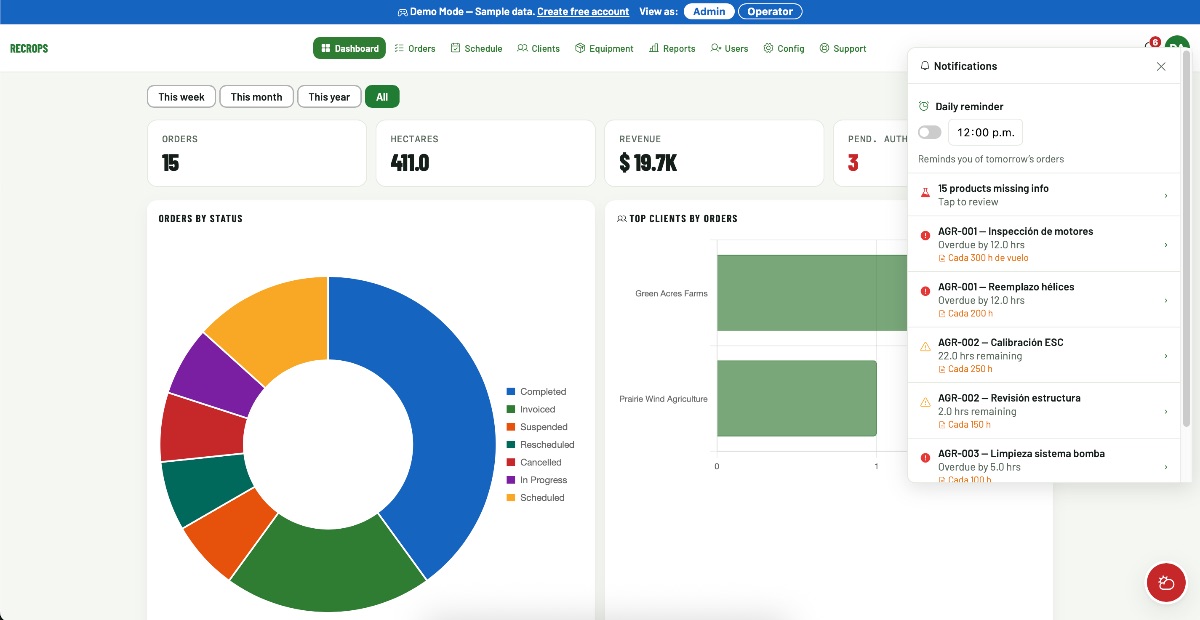
The Dashboard shows the whole operation live — orders, hectares, revenue, pending authorisations. Reports turns a season of applications into the number that matters: what each crop and each block actually cost you to protect, and what came back. Spray records you never look at are a tax. Spray records you can query are the cheapest agronomy you will ever buy.
Whatever you fly, drive or carry
Nothing above assumed a specific machine, and neither does the software. Equipment holds the whole fleet in a single registry — aircraft, drones, ground rigs, tractors, mist blowers, backpacks — with maintenance alerts so a service interval does not get discovered the morning of a job.
Recrops was built for agricultural application as a whole: aerial, ground and manual. A backpack applicator on two hectares and a spray plane on two thousand are keeping the same record and answering to the same rules.
When more than one person touches the job
The moment you have a second sprayer, a pilot, an office admin or a seasonal hire, the record stops being yours alone — and so does the risk. Users & Roles gives each person exactly the access they need and nothing they do not: the operator logs the application, the office bills it, the owner sees the margin, and nobody can quietly edit a completed record.
Frequently asked questions
What is a spray record?
A spray record is the documented proof of a single pesticide or fertiliser application. At minimum it names the product and its registration number, the date and time, the dose, the treated area and crop, the person who applied it, the weather at the time and the reason for the application.
How long do I have to keep spray records?
It depends on where you spray. In the EU, professional users must keep records for at least three years. In the United States, private applicators must keep records of Restricted Use Pesticide applications for two years. GLOBALG.A.P. audits generally look back two years. Keeping them longer costs nothing digitally, so the practical answer is: keep them permanently.
Do spray records have to be digital?
In the EU, yes — from 1 January 2026, professional users must keep records electronically in a machine-readable format under Regulation (EU) 2023/564. Field notes on paper are still allowed as a first capture, but they must be transferred to electronic form within 30 days, with longer transition periods available until 31 January 2030. Elsewhere, paper is generally still legal, but certification schemes and buyers increasingly ask for records they can query.
Do drone spraying operations need the same records as ground or aerial applicators?
Yes. Record keeping obligations follow the pesticide and the treated area, not the machine that carried it. A spray drone operator records the same fields as a boom sprayer or a spray plane, and in most jurisdictions carries additional aviation obligations on top.
What is Delta T and why does it matter for spraying?
Delta T is the difference between the dry bulb and wet bulb air temperature, and it predicts how quickly spray droplets evaporate. A Delta T of 2 to 8 is generally considered ideal for spraying. Below 2 droplets survive too long and drift risk rises; above 8 they evaporate before reaching the target and efficacy drops.
Can I keep spray records without internet in the field?
You should be able to. Coverage in the field is the single most common reason record keeping fails — the application happens where there is no signal and gets written up hours later from memory, which is how times, doses and weather quietly become approximations.
The bottom line
The record is not the paperwork at the end of the job. It is the job. What you decide before you spray — the window, the mix, the dose — is what the record will eventually say about you, and from 2026 an increasing share of the industry will have to say it in a format a regulator, a buyer or an auditor can read directly.
Whether you carry a backpack, drive a rig or fly, the fields are the same. Recrops was built to capture them once, at the moment of the application, and turn them into the invoice, the compliance record and the margin report without anyone retyping anything.
General guidance only. Pesticide record keeping requirements vary by country, state and product. Always follow the product label and your local regulations, and consult a licensed agronomist or your competent authority for your specific situation.
Sources: Commission Implementing Regulation (EU) 2023/564; Regulation (EC) No 1107/2009, Article 67; USDA Agricultural Marketing Service, Pesticide Recordkeeping; GLOBALG.A.P. Integrated Farm Assurance; North Dakota State University Extension.